Aufgabe 6018
Abitur 2015 Gymnasium Bayern - Prüfungsteil B - Analysis
Angabe mit freundlicher Genehmigung vom Bayerischen Staatsministerium für Bildung und Kultus, Wissenschaft und Kunst
Gegeben ist die Funktion f mit
\(f\left( x \right) = \dfrac{1}{{x + 1}} - \dfrac{1}{{x + 3}}{\text{ mit }}{D_f} = {\Bbb R}\backslash \left\{ { - 3; - 1} \right\}\).
Der Graph von f wird mit Gf bezeichnet.
1. Teilaufgabe a) 4 BE - Bearbeitungszeit: 9:20
Zeigen Sie, dass f (x) zu jedem der drei folgenden Terme äquivalent ist:
- Term 1: \(\dfrac{2}{{\left( {x + 1} \right) \cdot \left( {x + 3} \right)}}\)
- Term 2: \(\dfrac{2}{{{x^2} + 4x + 3}}\)
- Term 3: \(\dfrac{1}{{0,5 \cdot {{\left( {x + 2} \right)}^2} - 0,5}}\)
2. Teilaufgabe b.1) 1 BE - Bearbeitungszeit: 2:20
Begründen Sie, dass die x-Achse horizontale Asymptote von Gf ist.
3. Teilaufgabe b.2) 1 BE - Bearbeitungszeit:2:20
Geben Sie die Gleichungen der vertikalen Asymptoten von Gf an.
4. Teilaufgabe b.3) 1 BE - Bearbeitungszeit: 2:20
Bestimmen Sie die Koordinaten des Schnittpunkts von Gf mit der y-Achse.
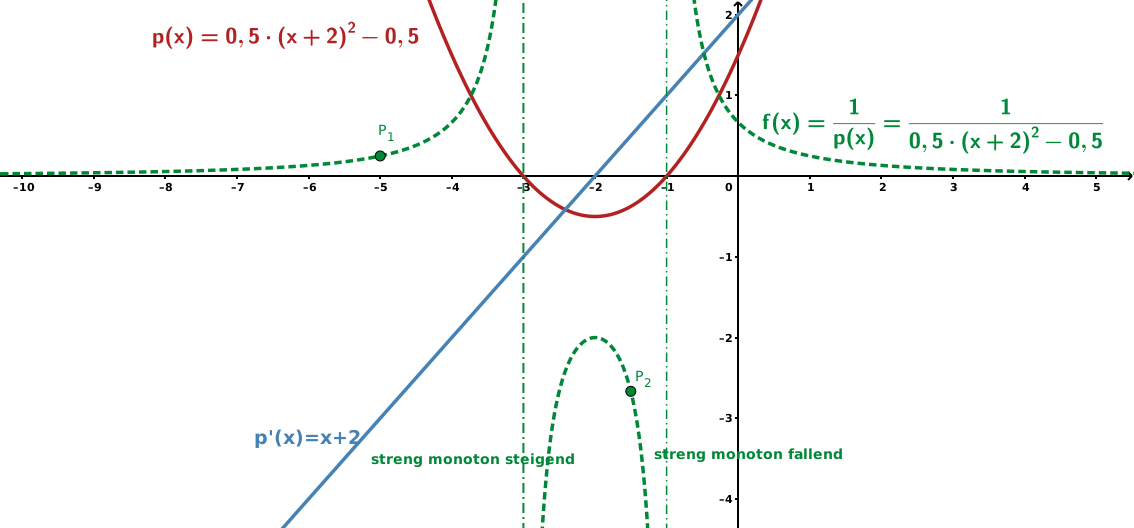
Die nachfolgende Abbildung 1 zeigt den Graphen der in \({\Bbb R}\) definierten Funktion
\(p:x \mapsto 0,5 \cdot {\left( {x + 2} \right)^2} - 0,5\), die die Nullstellen x=- 3 und x=-1 hat.
Für \(x \in {D_f}{\text{ gilt }}f\left( x \right) = \dfrac{1}{{p\left( x \right)}}\)
Gemäß der Quotientenregel gilt für die Ableitungen f‘ und p‘ die Beziehung
\(f'\left( x \right) = - \dfrac{{p'\left( x \right)}}{{{{\left( {p\left( x \right)} \right)}^2}}}{\text{ für x}} \in {{\text{D}}_f}\)
5. Teilaufgabe c.1) 1 BE - Bearbeitungszeit: 2:20
Zeigen Sie unter Verwendung dieser Beziehung und ohne Berechnung von f‘(x) und p‘(x), dass x=-2 einzige Nullstelle von f‘ ist.
6. Teilaufgabe c.2) 1 BE - Bearbeitungszeit: 2:20
Zeigen Sie unter Verwendung dieser Beziehung und ohne Berechnung von f‘(x) und p‘(x), dass Gf in \(\left] { - 3;2} \right[\) streng monoton steigend ist
7. Teilaufgabe c.3) 1 BE - Bearbeitungszeit: 2:20
Zeigen Sie unter Verwendung dieser Beziehung und ohne Berechnung von f‘(x) und p‘(x), dass Gf in \(\left] { - 2; - 1} \right[\) streng monoton fallend ist.
8. Teilaufgabe c.4) 2 BE - Bearbeitungszeit: 4:40
Geben Sie Lage des Extrempunkts von Gf an.
Geben Sie Art des Extrempunkts von Gf an.
9. Teilaufgabe d.1) 2 BE - Bearbeitungszeit: 4:40
Berechnen Sie f (-5) und f (-1,5)
10. Teilaufgabe d.2) 2 BE - Bearbeitungszeit: 4:40
Skizzieren Sie Gf unter Berücksichtigung der bisherigen Ergebnisse in Abbildung 1.
Lösungsweg
1. Teilaufgabe:
1. Term:
\(\eqalign{ & f\left( x \right) = \dfrac{1}{{x + 1}} - \dfrac{1}{{x + 3}}{\text{ = }} \cr & {\text{ = }}\dfrac{{1 \cdot \left( {x + 3} \right)}}{{(x + 1) \cdot \left( {x + 3} \right)}} - \dfrac{{1 \cdot \left( {x + 1} \right)}}{{\left( {x + 3} \right) \cdot \left( {x + 1} \right)}} = \cr & = \dfrac{{\left( {x + 3} \right) - (x + 1)}}{{(x + 1) \cdot \left( {x + 3} \right)}} = \cr & = \dfrac{{x + 3 - x - 1}}{{(x + 1) \cdot \left( {x + 3} \right)}} = \cr & = \dfrac{2}{{(x + 1) \cdot \left( {x + 3} \right)}}\,\,\,\,\,{\text{wzbw}}{\text{.}} \cr} \)
2. Term:
\(\eqalign{ & f\left( x \right) = \frac{1}{{x + 1}} - \dfrac{1}{{x + 3}}{\text{ = }} \cr & {\text{ = }}\dfrac{{1 \cdot \left( {x + 3} \right)}}{{(x + 1) \cdot \left( {x + 3} \right)}} - \frac{{1 \cdot \left( {x + 1} \right)}}{{\left( {x + 3} \right) \cdot \left( {x + 1} \right)}} = \cr & = \dfrac{{\left( {x + 3} \right) - (x + 1)}}{{(x + 1) \cdot \left( {x + 3} \right)}} = \cr & = \dfrac{{x + 3 - x - 1}}{{{x^2} + 3x + x + 3}} = \cr & = \dfrac{2}{{{x^2} + 4x + 3}}\,\,\,\,\,{\text{wzbw}}{\text{.}} \cr} \)
3. Term:
\(\eqalign{ & f\left( x \right) = \frac{1}{{x + 1}} - \dfrac{1}{{x + 3}}{\text{ = }} \cr & {\text{ = }}\dfrac{{1 \cdot \left( {x + 3} \right)}}{{(x + 1) \cdot \left( {x + 3} \right)}} - \dfrac{{1 \cdot \left( {x + 1} \right)}}{{\left( {x + 3} \right) \cdot \left( {x + 1} \right)}} = \cr & = \dfrac{{\left( {x + 3} \right) - (x + 1)}}{{(x + 1) \cdot \left( {x + 3} \right)}} = \cr & = \dfrac{{x + 3 - x - 1}}{{{x^2} + 3x + x + 3}} = \cr & = \frac{2}{{{x^2} + 4x + 3}} = \cr & = \dfrac{2}{{\left( {{x^2} + 4x + 4} \right) - 1}} = \cr & = \dfrac{2}{{{{\left( {x + 2} \right)}^2} - 1}} = \cr & = \dfrac{{0,5 \cdot 2}}{{0,5 \cdot \left[ {{{\left( {x + 2} \right)}^2} - 1} \right]}} = \cr & = \dfrac{1}{{0,5 \cdot {{\left( {x + 2} \right)}^2} - 0,5}}\,\,\,\,\,wzbw \cr} \)
2. Teilaufgabe:
x-Achse horizontale Asymptote von Gf
- Damit die x-Achse eine Asymptote ist, muss Zählergrad < Nennergrad gelten, was hier der Fall ist.
- Für \(x \to \pm \infty \) werden die beiden Nenner immer größer. Dadurch wird der Quotient immer kleiner und so nähert sich der Funktionswert f(x) dem Wert y=0 asymptotisch an.
Horizontale Asymptote:
\(f\left( x \right) = 0\)
3. Teilaufgabe:
Gleichungen der vertikalen Asymptoten von Gf
- Senkrechte (=vertikale) Asymptoten sind dort, wo sich die Polstellen (Definitionslücken) einer Funktion befinden und in deren Nähe die Funktionswerte gegen unendlich streben. Die senkrechten Asymptoten finden sich dort, wo der Nenner Nullstellen hat, die aber keine Nullstellen vom Zähler sind.
- Die Nullstellen vom Nenner kann man direkt zu x=-1 und x=-3 ablesen. Der Zähler hat keine Nullstellen.
Vertikale Asymptoten:
\(x = - 1;{\text{ und }}x = - 3\)
4. Teilaufgabe:
Koordinaten des Schnittpunkts von Gf mit der y-Achse
- Am Schnittpunkt von Gf mit der y-Achse gilt: x=0
\(\eqalign{ & f\left( {x = 0} \right) = \dfrac{1}{{x + 1}} - \dfrac{1}{{x + 3}} = \cr & = \dfrac{1}{{0 + 1}} - \dfrac{1}{{0 + 3}} = 1 - \dfrac{1}{3} = \dfrac{2}{3} \cr} \)
Schnittpunkt:
\(S = \left( {0\left| {\dfrac{2}{3}} \right.} \right)\)
5. Teilaufgabe:
x=-2 einzige Nullstelle von f‘
Wir fassen die Angabe wie folgt zusammen:
\(\eqalign{ & p(x) = 0,5 \cdot {\left( {x + 2} \right)^2} - 0,5 \cr & {\text{p(x): NST: }}x = - 3{\text{ und }}x = - 1 \cr & \cr & f(x) = \dfrac{1}{{p\left( x \right)}} = \dfrac{1}{{0,5 \cdot {{\left( {x + 2} \right)}^2} - 0,5}} \cr & f'\left( x \right) = - \dfrac{{p'\left( x \right)}}{{{{\left( {p\left( x \right)} \right)}^2}}} \cr & {\text{f'(x): NST: }}x = - 2 \cr} \)
Wir entnehmen dem gegebenen Graph p(x) dass dieser an der Stelle x=-2 eine Extremstelle (lokales Minimum) hat. Gemäß der NEW-Regel muss daher die 1. Ableitung, also p‘(x) an dieser Stelle eine Nullstelle haben. p‘(x=-2)=0.
Da die gegebene Parabel nur eine Extremstelle hat, kann es auch nur eine Nullstelle für p‘(x) geben.
Alternativ:
Die Ableitung einer quadratischen Funktion ist eine lineare Funktion und eine lineare Funktion kann nur 1. Nullstelle haben.
\(p'\left( x \right) = 0 \to f'\left( x \right) = - \dfrac{{p'\left( x \right) = 0}}{{{{\left( {p\left( x \right)} \right)}^2}}} = 0\)
An der Stelle x=-2 liegt die einzige Nullstelle von f‘(x).
6. Teilaufgabe:
Gf in \(\left] { - 3;2} \right[\) streng monoton steigend:
- Im Intervall \(\left] { - 3;2} \right[\) ist der Graph der gegebenen Funktion p(x) streng monoton fallend.
- Wenn p(x) streng monoton fallend ist, dann muss p‘(x)<0 gelten
- Somit gilt
\(f'\left( x \right) = - \dfrac{{p'\left( x \right) < 0}}{{{{\left( {p\left( x \right)} \right)}^2}}} \to f'\left( x \right) > 0\)
(Vor dem Bruch steht ein Minus, im Zähler steht ein Minus, daher ist der Quotient positiv.) - \(f'\left( x \right) > 0 \to \operatorname{f} {\text{ steigt streng monoton wzbw}}\)
7. Teilaufgabe:
Gf in \(\left] { - 2; - 1} \right[\)streng monoton fallend:
- Im Intervall \(\left] { - 2; - 1} \right[\) ist der Graph der gegebenen Funktion p(x) streng monoton steigend.
- Wenn p(x) streng monoton steigend ist, dann muss p‘(x)>0 gelten
- Somit gilt
\(f'\left( x \right) = - \dfrac{{p'\left( x \right) > 0}}{{{{\left( {p\left( x \right)} \right)}^2}}} \to f'\left( x \right) < 0\)
(Vor dem Bruch steht ein Minus, im Zähler steht ein Plus, daher ist der Quotient negativ.) - \(f'\left( x \right) < 0 \to \operatorname{f} {\text{ fällt streng monoton wzbw}}\)
8. Teilaufgabe:
Lage und Art des Extrempunkts von Gf
(Hier nicht gefragt: Die Funktion f(x) hat an den Stellen x=-3 und x=-1 je eine Polstelle.)
- Aus der Angabe wissen wir, dass der Graph von f links von x=-2 streng monoton steigend ist
- Aus der Angabe wissen wir, dass der Graph von f rechts von x=-2 streng monoton fallend ist
Daher hat f(x) an der Stelle x=-2 ein lokales Maximum, welches sich wie folgt berechnet:
\(\eqalign{ & f(x) = \dfrac{1}{{p\left( x \right)}} = \dfrac{1}{{0,5 \cdot {{\left( {x + 2} \right)}^2} - 0,5}} \cr & f\left( {x = - 2} \right) = \dfrac{1}{{0,5 \cdot {{\left( { - 2 + 2} \right)}^2} - 0,5}} = \dfrac{1}{{ - 0,5}} = - 2 \cr} \)
Das lokale Maximum, also der lokale Hochpunkt, hat die Koordinaten:
\(H = \left( { - 2\left| { - 2} \right.} \right)\)
9. Teilaufgabe:
(-5) und f (-1,5)
\(\eqalign{ & f(x) = \dfrac{1}{{p\left( x \right)}} = \dfrac{1}{{0,5 \cdot {{\left( {x + 2} \right)}^2} - 0,5}} \cr & f\left( {x = - 5} \right) = \dfrac{1}{{0,5 \cdot {{\left( { - 5 + 2} \right)}^2} - 0,5}} = \cr & = \dfrac{1}{{0,5 \cdot {{\left( { - 3} \right)}^2} - 0,5}} = \dfrac{1}{{0,5 \cdot 9 - 0,5}} = \dfrac{1}{{4,5 - 0,5}} = \frac{1}{4} = 0,25 \cr & {P_1} = ( - 5\left| {0,25)} \right. \cr & \cr & f\left( {x = - 1,5} \right) = \dfrac{1}{{0,5 \cdot {{\left( { - 1,5 + 2} \right)}^2} - 0,5}} = \cr & = \dfrac{1}{{{{0,5}^3} - 0,5}} = - \dfrac{8}{3} \approx - 2,66 \cr & {P_2} = \left( { - 1,5\left| { - 2,66} \right.} \right) \cr} \)
10. Teilaufgabe:
Skizzieren Sie Gf
Ergebnis
Die richtige Lösung lautet:
1. Teilaufgabe:
Durch Umformungen kann gezeigt werden, dass die drei Terme äquivalent sind
2. Teilaufgabe:
Horizontale Asymptote: \(f\left( x \right) = 0\)
3. Teilaufgabe:
Vertikale Asymptoten: \(x = - 1;{\text{ und }}x = - 3\)
4. Teilaufgabe:
\(S = \left( {0\left| {\dfrac{2}{3}} \right.} \right)\)
5. Teilaufgabe:
An der Stelle x=-2 liegt die einzige Nullstelle von f‘(x).
6. Teilaufgabe:
Gf ist im Intervall \(\left] { - 3;2} \right[\) streng monoton steigend.
7. Teilaufgabe:
Gf ist im Intervall \(\left] { - 2; - 1} \right[\) streng monoton fallend.
8. Teilaufgabe:
Das lokale Maximum, also der lokale Hochpunkt, hat die Koordinaten:
\(H = \left( { - 2\left| { - 2} \right.} \right)\)
9. Teilaufgabe:
\({P_1} = ( - 5\left| {0,25)} \right.\)
\({P_2} = \left( { - 1,5\left| { - 2,66} \right.} \right)\)
10. Teilaufgabe: